BASED IN USA
BALANCE BUDDY
Unplug, step out, live more

🌱 TABLE OF CONTENTS
WHAT I DID
-
Collaborated on user research, storyboarding, and usability testing to define the problem and user needs
-
Co-designed and iterated prototypes, improving the experience based on team feedback and user insights
ROLE AND TEAM
I worked as a UX Designer, collaborating with three other designers to create user-centered solutions.
TOOLS
Figma, Miro, Google Drive
DURATION
8 Weeks
Discovery - When the Scroll Doesn’t Stop!!
It started with just five minutes a quick scroll between classes, a photo posted, a reel watched. But five minutes turned to five hours and for many Gen Zers, that’s now the norm.
We discovered a growing unease beneath the glow of screens. While social media promised connection, creativity, and self-expression, it was quietly eroding something more vital: mental peace.
Platforms like Instagram, once spaces of inspiration, had become mirrors of comparison. Carefully curated lives and filtered perfection were fueling silent battles—anxiety, depression, and body image struggles—especially in younger audiences.
Out of 60 years, 6.7 are spent just scrolling.
That’s nearly a decade of missed moments !!
6.7 are spent scrolling
Avg person lives
The Scale of the Scroll
4.5 hours/day
That’s how long the average Gen Zer spends on social media.
6 years & 8 months
The total time a person is likely to spend scrolling in a lifetime.
80% of users
Have tried (and failed) to cut back their usage.
Mental health toll
Excessive use is increasingly tied to rising cases of anxiety, depression, and low self-worth.
HOW MIGHT WE. . . . . . .
How might we design a solution to reduce social media usage and encourage healthier habits?
🌱 OUR GOALS
Empower users to reduce screen time and rediscover balance.
Promote offline joy through playful, real-world nudges.
Tackle anxiety and self-image with built-in emotional care.
Give users smart tools to track, limit, and take control guilt-free.
🌟 The Solution
Meet Balance Buddy - Your Digital Wellness Wingman
In a world where scrolling is second nature, Balance Buddy steps in as a gentle, empowering force, helping users reclaim their time, focus, and peace of mind.
More than just an app, Balance Buddy is a habit-shifting companion. It pairs users with real accountability partners, turning intention into action. Through personalised digital detox challenges, focus modes, and positive nudges, it transforms the way users interact with technology without shame, guilt, or pressure.
The Goals ?
-
Not to delete apps, but to restore balance.
-
Not to shame usage, but to empower change.
-
Because your time belongs to you, not your feed.

Onboarding
After logging in or signing up, users are prompted to select their interests from multiple options. This helps in providing rewards tailored to the selected interests.

Choose Your Balance Buddy
You can choose your "Balance Buddy" who will help keep you accountable. Both you and your Balance Buddy will lock your apps together for the selected amount of time and date
Request Approval from Your Balance Buddy
A request will be sent to your Balance Buddy, and you cannot open the locked apps without their approval.
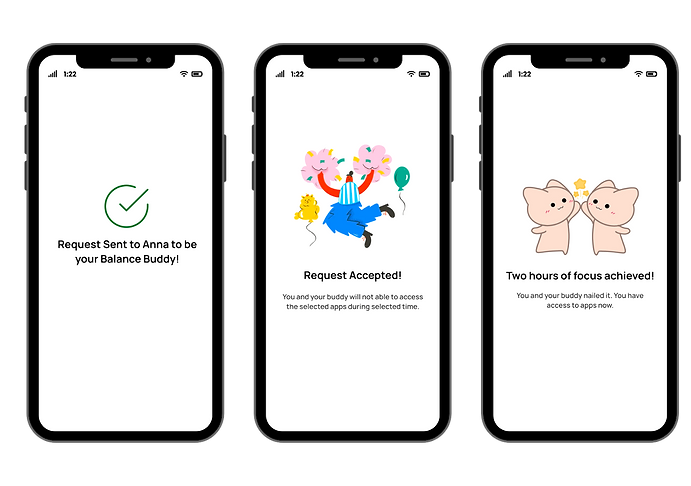

Rewards
Upon completing a challenge, users will receive rewards that are tailored to their interests. These rewards aim to recognize and encourage their efforts in balancing online and offline activities.
Challenges
This feature encourages users to balance online and offline time by engaging in outdoor activities. Users can choose from various challenges, and detailed information will be provided for each challenge. User can also keep track of progress by their balance buddy.

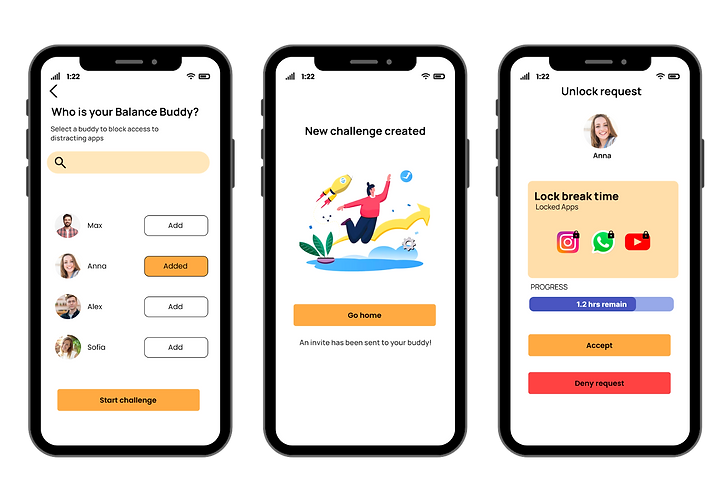
Early unlocking
Early unlock requests can be made, and your Balance Buddy can choose to accept or reject them.
Design Journey - How We Got Here !!
Research
To better understand the grip of smartphones in everyday moments, we conducted nine observational sessions across multiple public spaces. Each team member observed for 45 minutes in two unique locations, capturing behavior without interference.
Smartphones = The Default Companion
Even without notifications, people turned to their phones instinctively filling silence, boredom, or in-between moments.
70–80% of individuals reached for their phones while “waiting for the next thing” (e.g., food, friends, the bus).
~70% were completely absorbed, scrolling non-stop during the observation.
Those who weren’t fully engrossed still checked their screens at intervals every few minutes.
Even in groups, people weren’t present—over 50% of social pairs spent more time on their phones than with each other.
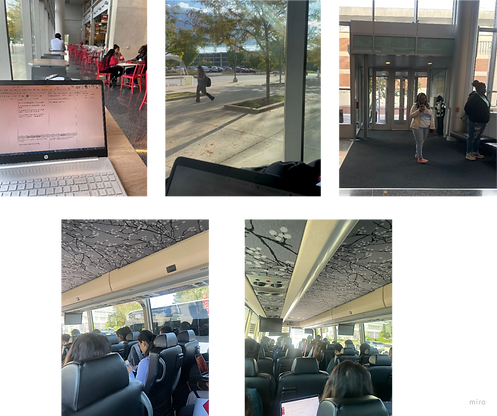
Photos Taken During Observation

Interview Insights
We conducted eight semi-structured interviews with participants ranging from students to working professionals. The aim was to understand their social media habits, triggers, motivations for using social media, and its effects.
Common themes emerged from the interviews:
-
Fear of missing out (FOMO).
-
Anxiety if a photo doesn't get enough likes.
-
An ingrained habit that is difficult to break.
-
Using social media as a form of distraction.
Notes Taken During Observation & Interview
Persona
From those insights, we created detailed personas that represented everyday users

Anna is a 22-year-old college student struggling to limit her social media usage. She grew up with technology and started using social media young. Initially, it helped her connect with friends, but over time it took over her life. Her addiction began affecting her academics, relationships, and overall well-being.
Anna John
Demographics
-
Age: 22 years old
-
Education: Graduate
-
Screen time: 8+ hours
-
Family: Single
-
Occupation: Student
Goals
-
Reduce her social media usage to improve her mental health
-
Strike a healthier balance between her online and offline life
-
The biggest challenge is FOMO (Fear of Missing Out)
"I want to focus more on my mental health and studies"
Frustrations
-
Loves being on social media, but it’s a huge distraction
-
Feels she’s becoming addicted

Steve’s behaviour on social media stems from a need to escape reality and reduce stress. He checks social media compulsively, even during work, to avoid overwhelming tasks. It acts as both a procrastination tool and a stress relief. During challenging work, he turns to social media to distract himself.
Steve Wilson
Demographics
-
Age: 33 years old
-
Education: Graduate
-
Screen time: 5–6 hours
-
Family: Married
-
Occupation: Finance
Goals
-
Balance social and real life
-
Maintain focus and productivity at work
-
Challenge is to overcome the habit of using social media
“I would love to balance my social media life with real life”
Frustrations
-
Trying to balance social media life with real life but is unsuccessful
Affinity Mapping
Making sense of what users told us
To analyse our qualitative data, interview quotes, survey responses, and observations, swe used Affinity Mapping. This helped us categorise, synthesize, and prioritise the core problems and emotional patterns users faced around social media usage.
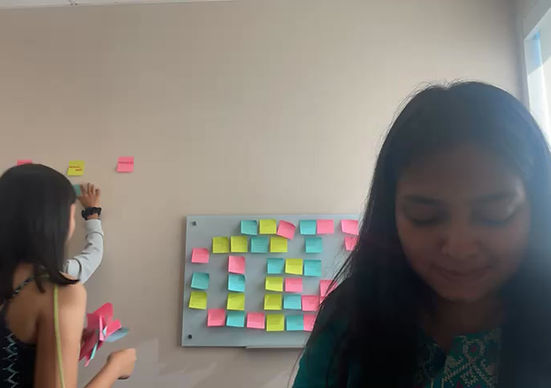

What We Learned
1. ChallengesThe biggest barrier to reducing screen time wasn’t awareness, it was a lack of self-control and motivation
2. TriggersUsers turned to social media when they felt bored, emotionally overwhelmed, or wanted to avoid social interaction.
3. Emotional ChangesPost-usage, users frequently experienced anxiety, guilt, or even depression, especially after extended sessions or comparison, driven content.
4. ReplacementsMany expressed a desire to replace scrolling with activities like spending time with family, cleaning, or gardening but needed structure or accountability to do so.
"I don’t even enjoy scrolling—it's just a reflex when I feel awkward or bored."
By clustering insights, affinity mapping made it easier to translate emotional pain points into feature ideas like mood check-ins, mindful prompts, and goal-setting tools.
Empathy Mapping
After synthesizing data using Affinity Mapping, we had a solid understanding of common patterns, problems, and emotional triggers. To go deeper, we created Empathy Maps to humanize those findings and focus on what users were thinking, feeling, seeing, saying, doing, and hearing in specific moments.
🎯 Purpose of Empathy Mapping
To step into the users’ shoes and understand their emotional experience with social media on a more personal levelTo uncover the disconnect between what users say and what they feel or actually do


Storyboard
After shortlisting ideas, six storyboards were created, and one was finalized for prototyping.
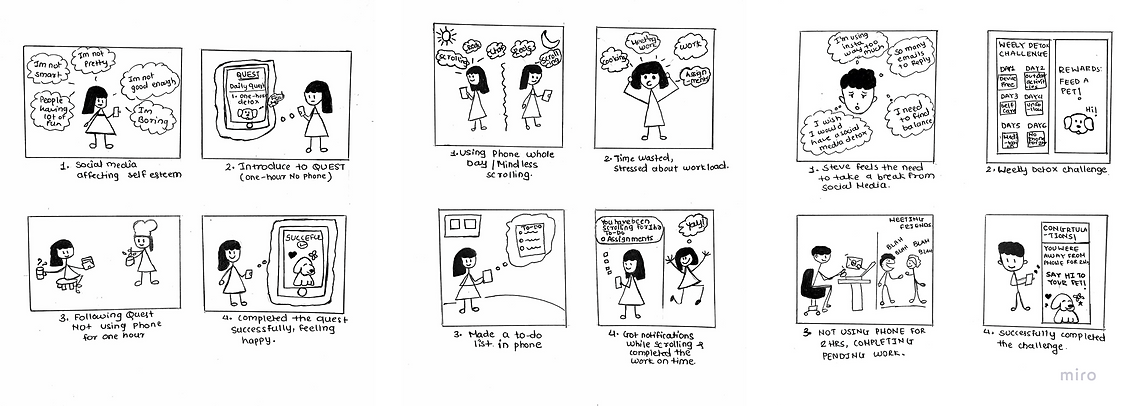
Storyboards were created to visualize user needs and map out the user journey.
Design Approach
Our design approach was rooted in creating a solution that supports motivation and builds healthy digital habits, not by restricting users, but by empowering them. Based on emotional insights and behavioural patterns from our research,
we focused on two main paths: social support and structured detoxing.
Insight-to-Feature Mapping
From our affinity mapping and empathy mapping,
We learned that:
-
Users struggle with self-control and lack of accountability
-
Social media is often used out of boredom or avoidance.
-
Users feel guilt and anxiety after usage, but still can’t stop.
-
Many wish to replace usage time with more meaningful offline activities
Behavior-Informed Framework
To translate these insights into actionable design, we followed a behavioral design framework:
-
Trigger: When a user opens social media mindlessly
-
Action: Introduce a small pause (mood check-in or challenge reminder)
-
Motivation: Boost through partner support or challenge incentives
-
Reward: Visual feedback, emotional wins, and positive reinforcement
Two Main Features
1. Accountability Partner System
Why: Users lacked motivation to self-regulate
How We Designed It:
-
Accountability partners act as a source of motivation; having someone who checks in on your progress or expects you to follow through can offer the extra encouragement needed to beat procrastination and stay on track.
Design Goal: Make digital wellness feel like a shared journey, not a solo struggle.
2. Detox Challenge Feature
Why: Users wanted achievable, motivating alternatives not strict blocks
How We Designed It:
-
Digital detox challenges help motivate users by setting clear, actionable goals that promote healthy boundaries between online and offline life. By offering achievable targets, they empower individuals to take control of their screen time and move toward a more balanced, intentional lifestyle.
Design Goal: Let users experience success in small doses and gain confidence in reducing their digital dependence.
Sketching
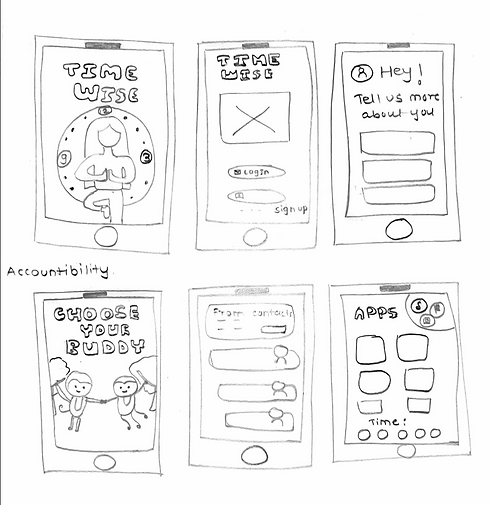
We conducted sketching sessions to explore the user flow of the app. Each team member brought different concepts to the table, and we selected the common flows that resonated with everyone. By combining the most promising ideas, we developed the concept for a mobile app.

Some of my sketches
Mid-Fidelity Design
Building upon the insights gathered from our sketches, we developed a mid-fidelity design to refine the app's functionality and user experience. This stage focused on visualizing the user flow and key features with more precision, allowing us to test interactions and validate assumptions.
The mid-fidelity prototype included essential app screens, such as the onboarding process, the selection of a "Balance Buddy," app locking functionality, and rewards tracking. It provided a clear structure for the user journey, highlighting areas for improvement and fine-tuning.
This design allowed us to gather valuable feedback, ensuring that the app would meet user needs while enhancing usability and engagement.


Things I learned
Research is Essential
Our project stood out because of strong research, which helped in understanding user needs and creating a better product. I realized that thorough research is the foundation of a successful design.
Talking to Users Matters
This was my first experience conducting interviews and gathering insights from real people. Understanding their emotions and opinions gave me a new perspective on user behavior and design decisions.
Testing Improves Design
User testing helped identify areas for improvement, making the product more user-friendly. I learned that design is an ongoing process of research, testing, and refinement.