BASED IN USA
HopeHaven: designing a safe space for women to heal after miscarriage.
Building a comforting, user-centered platform for emotional recovery after loss.
Project overview
Team: Aastha Bisen, Himali Trivedi, Joe Miller & Me
Created at: Indiana University
What I worked on
User research, Personas, Storyboarding, Prototyping, UI redesign
HopeHaven is a digital platform designed to support women recovering from miscarriage. It aims to create a safe space where users can find emotional support, access resources, and connect with others who share similar experiences. By addressing the silence and stigma surrounding miscarriage, HopeHaven encourages healing through empathy and community.
HopeHaven: finding hope through connection and compassion

The Challenge
-
Miscarriage is a silent battle for women with limited resources to help
-
Miscarriage leaves a profound impact emotionally and physically.
-
Our mission is to shatter the silence surrounding this often-overlooked issue, providing support and bringing to light the hidden aftermath experienced by countless women on this painful journey.
So the challenge was: how might we create a supportive digital space that breaks the silence, encourages healing, and helps women feel less alone?
The Approach
User research:
Interviews, personas, and literature review uncovered emotional, social, and informational needs of women experiencing miscarriage.
Insights synthesis:
Analysed findings to identify key pain points, emotional challenges, and gaps in existing support systems.
Ideation and brainstorming:
Held sessions to generate 50+ concepts, which were grouped into themes like connection, comfort, and education.
Storyboarding and prototyping:
Visualised user journeys through storyboards and paper prototypes, iterating to ensure usability, clarity, and emotional sensitivity.
The Research
We conducted 4 in-depth interviews, reviewed 50+ scholarly articles, and analyzed 30+ personal testimonies to understand the emotional, social, and informational challenges women face after miscarriage.
My research revealed several patterns that shaped the project direction.....
#1
Miscarriage is common, but its emotional impact is often hidden. Every 1 minute, 44 couples experience a miscarriage, yet societal silence makes it difficult to talk about. As a result, women often feel isolated and unsupported during their healing journey.
#2
Many women develop serious emotional and mental health challenges after miscarriage.
Nearly 1 in 3 women develop PTSD, 24% experience moderate to severe anxiety, and 11% face depression. These experiences highlight the urgent need for accessible mental health support.
#3
Partners and social networks are often unprepared to provide support.
40% of women find it hard to share their feelings with partners, and 51% feel like they’re “losing their mind.” This gap emphasises the need for guided peer and social support systems.
Interviews: uncovering first-hand insights
While secondary sources provided broad understanding, interviews revealed deeply personal experiences and emotional nuances that statistics could not capture.
We aimed to:
-
Understand the emotional language used when recounting miscarriage.
-
Identify gaps in support from healthcare, family, and society.
-
Explore how partners are often excluded from grief and healing.
-
Discover what types of support women wished existed during and after miscarriage.
Key insights from interviews:

“If someone had told me what to expect and walked me through what would happen and the decisions that I would have to make, I could have made better ones. I didn’t know, so I have to live with the regrets of flushing my first born baby down the toilet. She didn’t get a proper burial.” - Kristin

“When I shared the news with my mother-in-law, there was no follow-up or check-ins. No one inquired about how I was coping or feeling. It wasn't that I felt ashamed, but I certainly felt the weight of going through it alone.” - Rebecca
From this, We concluded…
Miscarriage support is insufficient, leaving women isolated and overwhelmed during an emotionally challenging time. Existing resources rarely address both emotional healing and peer connection in a safe, empathetic way.
This led to the questions:
-
How might we create a safe space for women to share their stories and connect with peers who understand their experiences?
-
How might we provide accessible emotional and mental health support throughout the recovery journey?
-
How might we empower partners and caregivers to better support women during this time?
…which guided the high-level objectives for designing HopeHaven, a peer-centered support platform for miscarriage recovery.
The Ideation and Brainstorming
We conducted 3 brainstorming sessions which generated 76 ideas. Keeping our users needs and goals in mind, we finalized our solution.
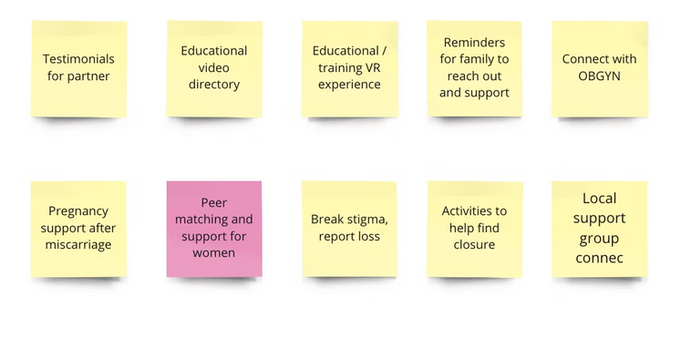
Our last brainstorming session (the session where we found our solution!)
The Solution
A personalized matching application that facilitates connections between women who have recently experienced a miscarriage and are seeking support, and those who have experienced a miscarriage some time ago to establish meaningful connections that foster empathy and contribute to the healing journey.


This was our final paper prototype, which we performed an internal walkthrough on.
Paper Prototype
Mid-Fidlity


A few of the wireframes from 1st iteration
The Final Prototype

Onboarding:
As part of the onboarding process, users will be asked a series of questions to help find the best match for their needs.
These questions are divided into four categories:
-
Basic Info: Age and zip code to match users by age and location.
-
Miscarriage Details: Questions about miscarriage experiences to pair users with similar backgrounds.
-
Support System: Questions about the support from partners, friends, and family during recovery.
-
Health Information: Questions about medical experiences to understand user treatment by healthcare providers.
Matches Screen
The app suggests the best matches based on onboarding responses. Users can search and filter results to find meaningful connections. Each profile shares a short story, helping users choose who they’d like to connect with.


Jana L. Seitz, MD
Obstetrics & Gynecology @IU Health
Validating our solution
We talked to Dr. Jana L. Seitz who said-
“This app idea could be very powerful. It is my job as a medical professional to give patients what they need from a medical perspective. But there are mental and emotional health concerns too. This app has the potential to address the unique needs of women.”
Things I Learned
The power of understanding
True design impact starts with empathy. Listening to users and learning from their real experiences helped me see the problem beyond assumptions and statistics — through human stories that guided every design choice.
The value of feedback
I learned that feedback isn’t criticism; it’s perspective. Inviting others’ opinions and staying open to change helped me refine my ideas and design a solution that truly resonates with users’ emotions and needs.